


For a greenhouse project, calculating the required shade net is not simply a matter of multiplying the greenhouse length by its width.
The actual quantity depends on the area that needs to be covered, the greenhouse structure, the installation method, the width and length of the rolls, overlap requirements, and the amount of material that may be lost during cutting and installation.
This is particularly important for shade net distributors, greenhouse contractors, agricultural companies, and importers buying in bulk.
A small calculation error may not matter much on a small order. On a large project, however, even a few percent of unnecessary material can mean hundreds or thousands of extra square meters, additional freight, and more installation work.
This guide explains a practical way to calculate shade net requirements before requesting a quotation from a manufacturer.
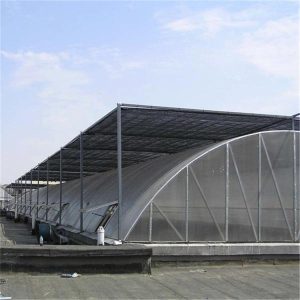
1. First Decide Exactly What Needs to Be Covered
Before calculating the quantity, determine where the shade net will be installed.
A greenhouse project may require netting on:
- The roof
- Both side walls
- End walls
- External shading structures
- Seedling or nursery areas
- Open cultivation areas
- Temporary seasonal structures
Do not automatically use the greenhouse floor area as the shade net quantity.
For example, a greenhouse with a floor area of 2,000 m² may require more than 2,000 m² of shade net if the roof is sloped, curved, or if the side walls are also covered.
The first question should therefore be:
What exact surfaces will the shade net cover?
Once this is clear, the calculation becomes much easier.
2. Basic Area Calculation
For a simple rectangular surface, use:
Length × Width = Area
For example:
A greenhouse roof is 50 m long and 20 m wide.
50 m × 20 m = 1,000 m²
So the theoretical roof coverage is 1,000 m².
If the project also requires shade net on the side walls, calculate those areas separately.
For example:
Two side walls:
50 m × 3 m × 2 = 300 m²
Two end walls:
20 m × 3 m × 2 = 120 m²
Theoretical total coverage:
1,000 + 300 + 120 = 1,420 m²
This is the starting point, not necessarily the final order quantity.
3. Roof Shape Matters
One of the easiest ways to underestimate the required quantity is to calculate a curved or sloped greenhouse using only its horizontal footprint.
Consider a tunnel greenhouse.
If the greenhouse is 30 m wide from one side to the other, the actual curved roof surface is longer than the 30 m horizontal distance.
The same applies to:
- Gable roofs
- Sloped roofs
- Multi-span greenhouses
- Curved structures
- Other non-flat greenhouse designs
For projects with complicated structures, it is useful to provide the manufacturer with:
- Greenhouse drawings
- Roof dimensions
- Span width
- Roof height
- Side-wall height
- Number of spans
- Photos of the structure
A simple sketch with dimensions can already be very useful.
The more accurately the factory understands the installation area, the more useful the quotation will be.
4. Calculate Different Areas Separately
For a commercial project, it is better to break the calculation into sections instead of using one large number.
For example:
Roof
80 m × 25 m = 2,000 m²
Side Walls
80 m × 4 m × 2 = 640 m²
End Walls
25 m × 4 m × 2 = 200 m²
Theoretical Total
2,000 + 640 + 200 = 2,840 m²
This method makes it easier to check the calculation later.
It also helps the factory understand exactly how the material will be used.
If the buyer only sends:
"We need approximately 3,000 m² of shade net."
the manufacturer knows the quantity, but not necessarily the installation arrangement.
Providing the dimensions is much better.
5. Roll Width Can Change the Final Quantity
This is where project purchasing becomes more complicated.
Suppose the required coverage is approximately 2,000 m².
A factory offers:
5 m × 100 m per roll
Each roll contains:
5 × 100 = 500 m²
In theory:
2,000 ÷ 500 = 4 rolls
But four rolls are only the theoretical area calculation.
You still need to check whether the 5 m width actually works with the greenhouse structure.
If the installation width is 4.2 m, for example, part of the material may need to be cut or folded.
If the installation width is 10 m, two 5 m pieces may need to be joined.
Therefore, total square meters and actual roll configuration are two different questions.
For a large project, both need to be considered.
6. Don’t Automatically Choose the Widest Available Net
A wider roll may look more economical because it can reduce the number of rolls.
But that does not necessarily mean it will produce the lowest total project cost.
The buyer should consider:
- Cutting waste
- Number of seams
- Installation labor
- Handling difficulty
- Packaging
- Transportation
- Actual greenhouse dimensions
For example, a 6 m wide net may be excellent for one greenhouse structure but inefficient for another.
This is why customized width can be valuable for commercial projects.
If the factory can produce a width that matches the installation requirements more closely, the buyer may reduce unnecessary cutting and waste.
7. Consider Overlap During Installation
Shade net is often installed in sections rather than as one continuous piece.
Depending on the fixing system and project requirements, adjacent sections may need to overlap.
The required overlap depends on:
- Installation method
- Fixing accessories
- Greenhouse structure
- Local wind conditions
- Installer requirements
- Whether the net is temporary or permanent
For this reason, a calculation based purely on geometric area may underestimate the actual material required.
The buyer should discuss the installation method with the contractor or manufacturer before confirming the final quantity.
8. Allow for Cutting and Installation Waste
Some material loss is normal.
Waste can come from:
- Cutting around greenhouse structures
- Trimming edges
- Overlapping sections
- Irregular roof shapes
- Doors and ventilation areas
- Installation adjustments
- Damaged pieces during installation
The amount of waste varies from project to project.
A simple rectangular greenhouse using standard roll dimensions may have relatively little waste.
A curved or multi-section greenhouse may require more.
It is better to calculate this based on the actual installation layout instead of adding an arbitrary percentage to every project.
9. How to Calculate the Number of Rolls
Once the usable roll dimensions are known, the basic formula is:
Required Area ÷ Area per Roll = Theoretical Number of Rolls
For example:
Required area:
2,400 m²
Shade net:
6 m × 100 m
Area per roll:
6 × 100 = 600 m²
Theoretical quantity:
2,400 ÷ 600 = 4 rolls
But before confirming four rolls, check the actual installation layout.
If overlap, cutting, or additional covered areas require more material, the final quantity may need to be increased.
For this reason, a factory quotation should ideally show both:
Roll specification + Total quantity
rather than only giving a price per roll.
10. GSM Is Important When Comparing Different Products
GSM means grams per square meter.
It is a useful specification when comparing shade nets, but it should not be considered independently.
For example, a buyer may receive two quotations for a 70% shade net.
Supplier A:
- 70% shade
- 90 GSM
Supplier B:
- 70% shade
- 120 GSM
These products should not automatically be treated as equivalent simply because both are described as "70% shade net."
Other factors should also be checked:
- Raw material
- GSM
- Mesh structure
- UV stabilization
- Yarn construction
- Width
- Length
- Manufacturing tolerance
- Intended application
This is especially important when comparing low-cost quotations from different factories.
11. Shade Rate Does Not Determine Quantity
The required area is normally determined by the physical coverage.
For example, if a greenhouse requires 2,500 m² of coverage, choosing a 50% shade net instead of a 70% shade net does not reduce the physical area that needs to be covered.
The shade rate changes the light-blocking performance, not the size of the greenhouse.
These two concepts should therefore be kept separate:
Coverage area = physical quantity
Shade rate = performance specification
Both should be clearly stated in the purchase order.
12. Example of a Complete Project Calculation
Consider a greenhouse project with the following requirements:
- Greenhouse length: 100 m
- Greenhouse width: 30 m
- Side-wall height: 4 m
- Roof coverage: 3,000 m²
- Two side walls: 800 m²
- End walls: 240 m²
Theoretical total coverage is:
3,000 + 800 + 240 = 4,040 m²
Suppose the selected shade net is:
5 m × 100 m per roll
Each roll provides:
5 × 100 = 500 m²
The theoretical number of rolls is:
4,040 ÷ 500 = 8.08 rolls
Based purely on area, at least 9 standard rolls would be required.
However, the final order should still be checked against:
- Overlap
- Cutting
- Installation layout
- Roof geometry
- Side-wall requirements
- Roll orientation
- Actual finished dimensions
So the correct purchasing decision is not simply "round 8.08 up to 9."
The factory and installer should confirm whether nine standard rolls provide the most efficient configuration.
13. Why Project Buyers Should Discuss Roll Dimensions With the Factory
A common purchasing mistake is to decide the quantity first and the roll dimensions later.
For commercial projects, it is often better to consider both at the same time.
A factory may be able to offer:
- Standard width
- Custom width
- Standard roll length
- Custom roll length
A customized combination may reduce cutting and make installation easier.
This can be particularly useful for:
- Greenhouse contractors
- Agricultural distributors
- Large farms
- Government or agricultural projects
- Landscaping companies
- Importers buying container quantities
A small change in roll dimensions can sometimes make a significant difference to installation efficiency.
14. Packaging and Container Loading Also Matter
For international buyers, the calculation does not stop when the number of rolls has been confirmed.
The finished products also need to be packed and shipped.
Before placing a large order, confirm:
- Roll dimensions
- Roll weight
- Number of rolls per package
- Packaging material
- Carton or woven-bag requirements
- Pallet requirements, if any
- Total gross weight
- Total volume
- Container loading arrangement
This information is particularly important when purchasing by container.
A product may have a competitive factory price, but the final landed cost also depends on how efficiently it can be packed and loaded.
For export orders, ask the factory to provide packing information together with the quotation whenever possible.
15. What Should You Send to a Shade Net Factory?
If you want a manufacturer to calculate the quantity and prepare a quotation, send as much of the following information as you have.
Project Information
- Greenhouse length
- Greenhouse width
- Greenhouse height
- Roof type
- Number of greenhouses
- Number of spans
Product Requirements
- Shade rate
- Material
- GSM
- UV stabilization
- Color
- Preferred width
- Preferred roll length
Installation Information
- Roof only or roof + walls
- External or internal installation
- Overlap requirements
- Fixing method
- Special cutting requirements
Shipping Information
- Destination country
- Port, if known
- Required packaging
- Estimated order quantity
You do not need to know every specification before contacting the factory.
If you only have the greenhouse drawings and project dimensions, send those first.
An experienced manufacturer can help work out the practical product configuration.
16. Why It Is Better to Compare Complete Specifications
When buying shade net from China, buyers sometimes receive several quotations that appear very different.
One factory may quote USD X per square meter.
Another may quote a lower price.
A third factory may quote a higher price.
Before deciding which one is cheaper, check whether the products are actually comparable.
Compare:
Shade rate
Material
GSM
Width
Roll length
UV stabilization
Mesh structure
Packaging
Quantity
Trade terms
Only after these specifications are clear does the price comparison become meaningful.
The cheapest quotation is not necessarily the lowest-cost solution for the project.
17. Huifa Nets — Shade Net Manufacturer and Factory in China
Huifa Nets is a China manufacturer and factory supplying shade nets and other agricultural and plastic netting products to international buyers.
For project orders, buyers can discuss product specifications such as:
- Shade rate
- GSM
- Width
- Roll length
- Material
- UV stabilization
- Color
- Mesh structure
- Packaging
- Custom dimensions
If you already have a greenhouse drawing or project layout, you can provide it to the factory together with the required application and destination.
This allows the manufacturer to review the project and recommend a practical shade net configuration instead of simply sending a standard price list.
18. Shade Net Quantity Calculation Checklist
Before requesting a final quotation, make sure you have checked:
Actual area requiring coverage
Roof shape
Side-wall and end-wall areas
Number of greenhouse sections
Required shade rate
GSM
Material
UV stabilization
Net width
Roll length
Overlap requirements
Cutting allowance
Installation method
Packaging
Destination port
Once these details are clear, the factory can give you a much more useful quotation.
Conclusion
Calculating shade net for a greenhouse project is not just a simple area calculation.
The basic formula is:
Length × Width = Area
But a commercial project requires more consideration.
The actual purchasing quantity depends on the greenhouse structure, covered areas, roll dimensions, overlap, cutting, installation method, and final packaging requirements.
For international buyers, the best approach is to provide the manufacturer with the project dimensions first and then confirm the most efficient combination of:
Shade Rate + GSM + Material + Width + Roll Length + Total Quantity
Do not compare factory prices until the specifications are comparable.
If you have a greenhouse project and are unsure how much shade net you need, send the dimensions or project drawing to Huifa Nets.
We can review the requirements and help determine a suitable shade net specification and quantity for quotation.


 WhatsApp


